Newsroom-in-the-loop: what AI actually changes in editorial work
| David Sancha | 3 min read
Although public conversation about AI in journalism often centres on automated, unsupervised content, our experience working side by side with several newsrooms shows an integrated approach in the editorial workflow. And to illustrate that, we want to share some data.
At Xalok we develop the editorial CMS used by newsrooms across more than a dozen countries, which lets us see not what editors say about AI but what journalists actually do with it, task by task. From January to April 2026, journalists across 18 digital publications used Xalok Assistant 168,363 times. Around 1,200 had it within reach as they worked, and roughly one in five reached for it five to eight times a day. What it shows is a habit forming in real time.
1. The craft stays human, the support is AI
The clearest pattern in the data is also the most reassuring: newsrooms keep control of what they create and lean on AI for the work around it. Of every AI action journalists took, content creation accounted for 21%. Editing took the largest share at 48%, and distribution (SEO, tagging, translation, related content) another 31%.
So more than three-quarters of AI use happens around the article rather than inside its authorship. The core editorial act stays with the journalist; what gets delegated is the supporting work.
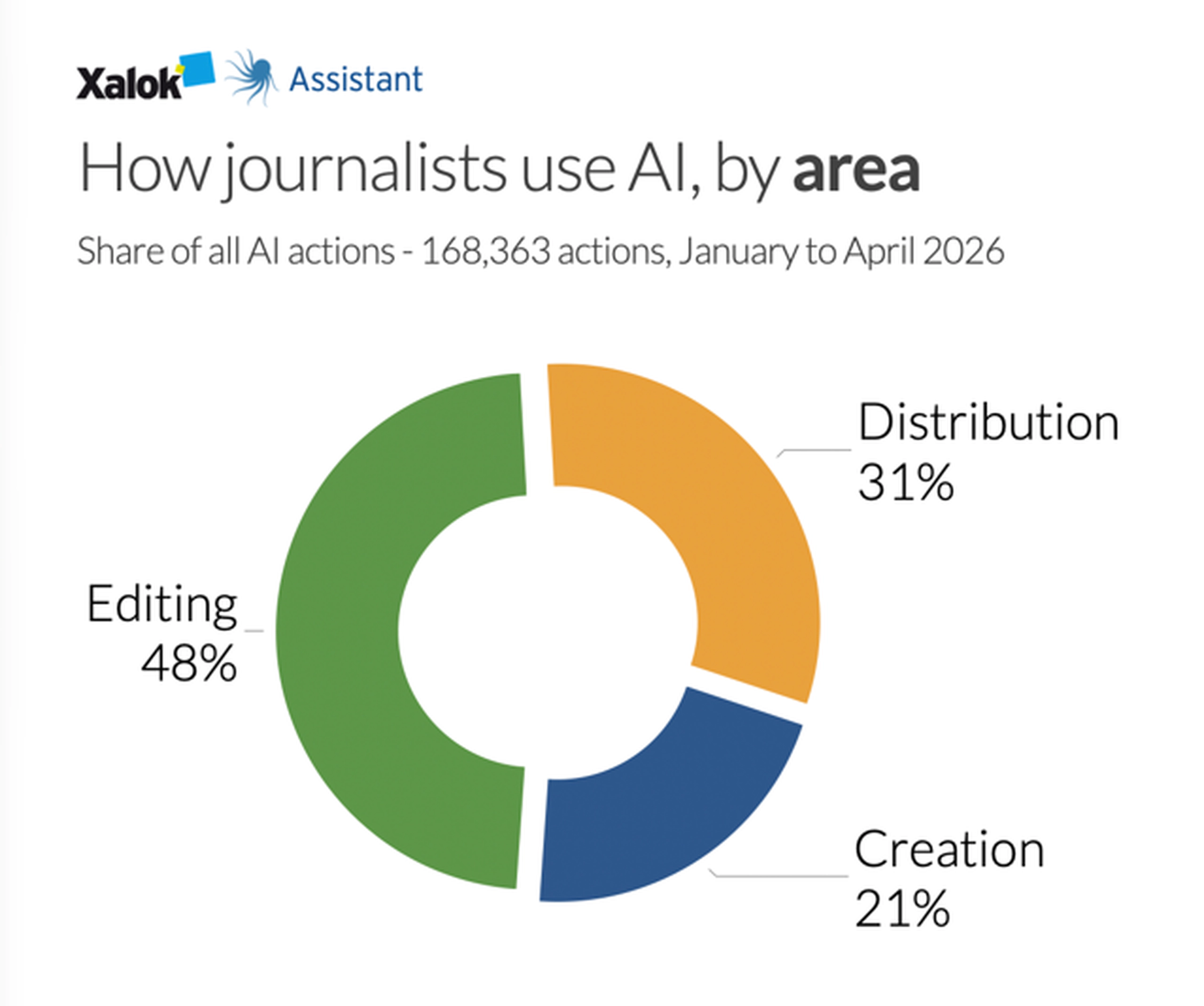
The pattern holds across newsrooms: given a capable tool and free rein, journalists choose to keep the writing.
2. What they delegate
Looking at individual functions tells the same story. The most-used actions are bold formatting (~23,000 uses), transcription (~20,500), tagging (~19,000), spell-checking (~18,500) and SEO metadata (~10,500). Headline generation sits far lower, at around 4,000.
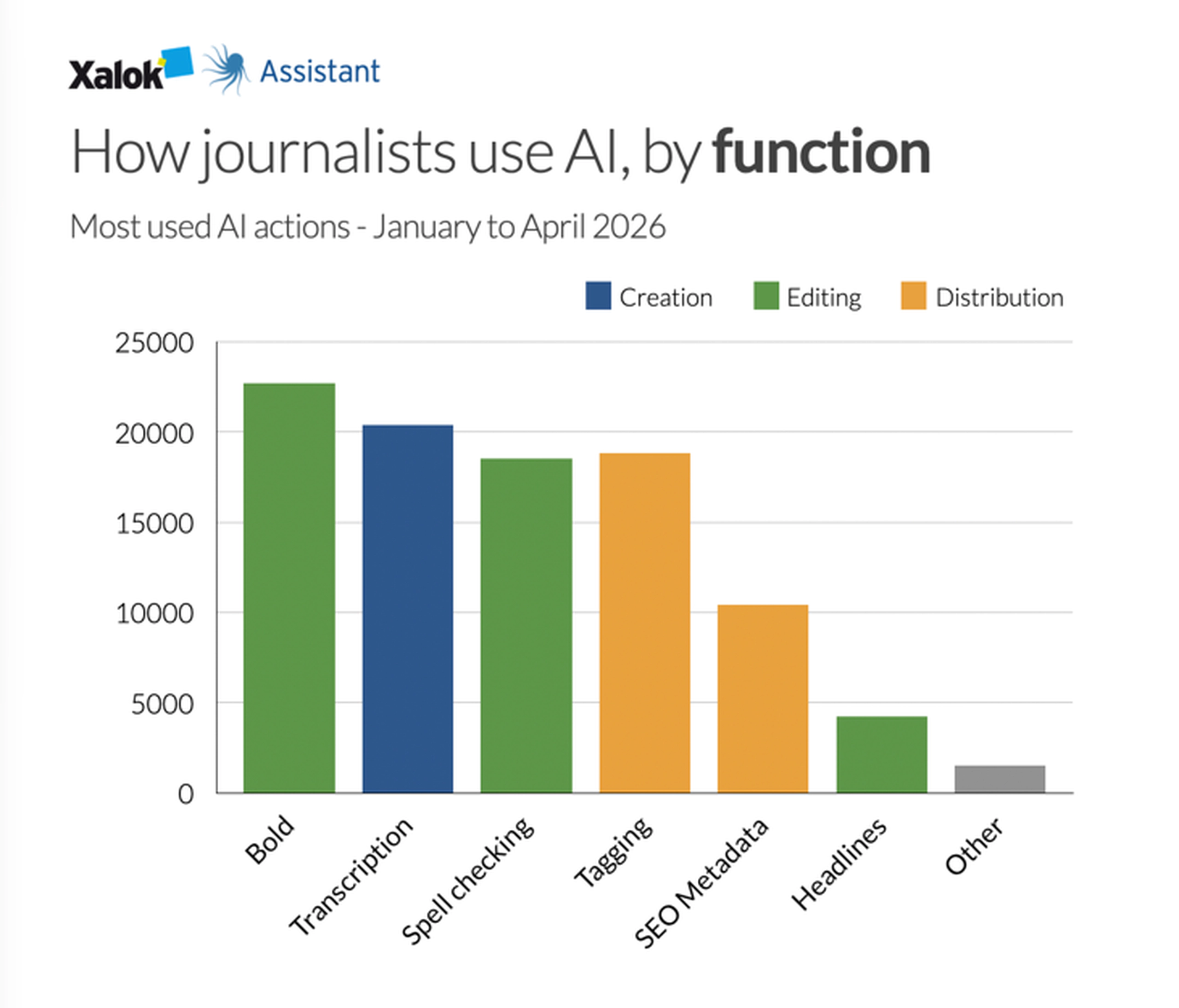
These are the repetitive, time-consuming tasks that sit between a journalist and a published story. They are the friction, not the craft. Read together, they suggest journalists are using AI to clear what does not need their judgment while keeping what does. The decisions that carry editorial responsibility, from framing to the final headline, stay in human hands.
This is the human-in-the-loop principle applied to a whole newsroom. As we like to call it, the result is a newsroom-in-the-loop: AI sits inside the workflow, but the journalist is always the pilot.
3. The more they use it, the more it sticks
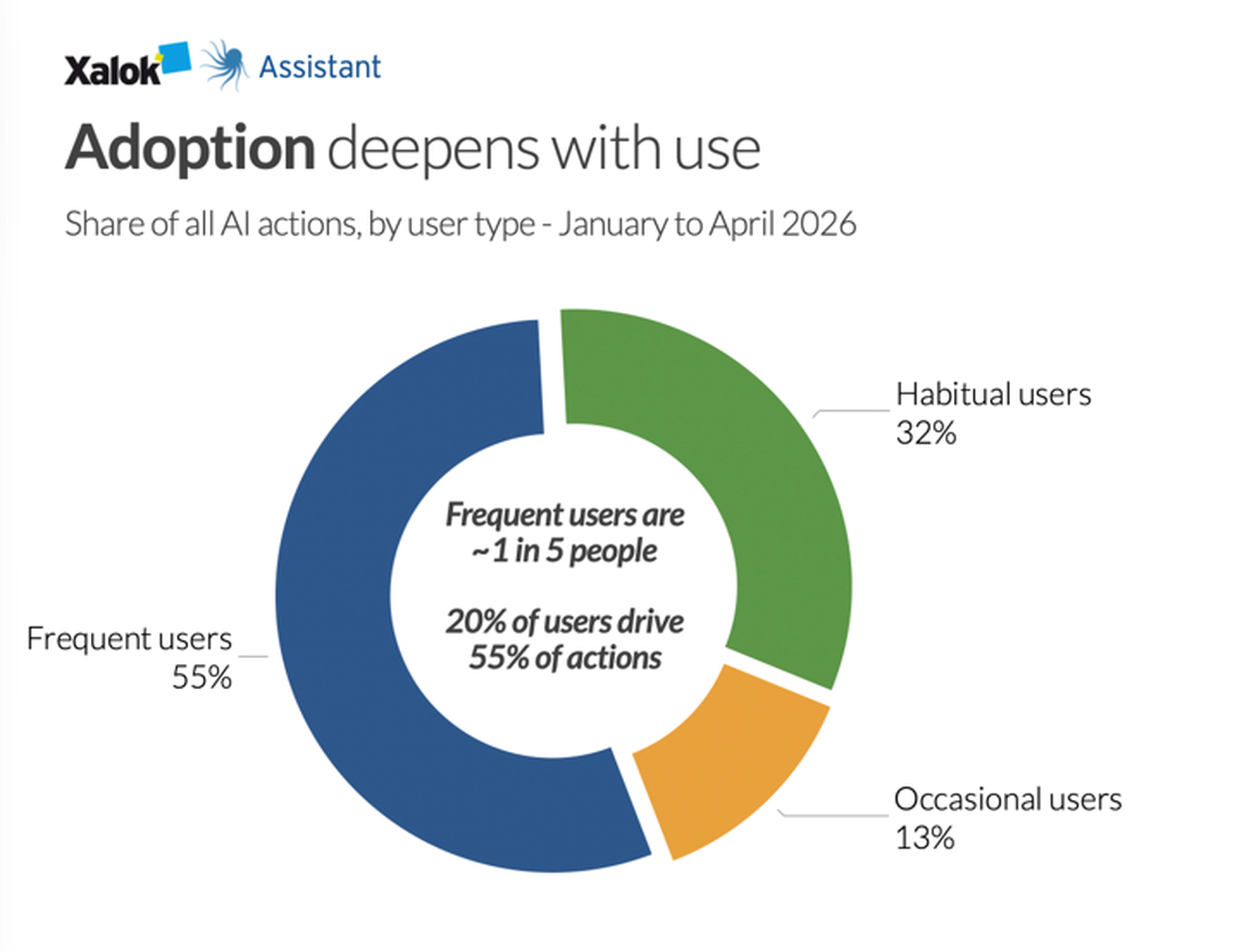
Adoption deepens with use. Around 20% of users account for 55% of all AI actions; a frequent user calls on the tool five to eight times a day, an occasional one once or twice a week. The journalists who fold it into their routine tend to use it more over time, not less. That is the mark of a tool becoming a habit rather than a curiosity.
What this contributes
Although our numbers measure how AI is used and not the outcomes it produces, we can share that some of the newsrooms working this way, radio and television groups among them using editorial transcription features, report up to 30% more digital output and, in some cases, AI-assisted content reaching up to 40% of their digital audience.
Conclusion
What the data suggests is that AI’s contribution to the newsroom is not authorship but the removal of friction. It gives journalists back the part of the day that was never the point, so more of their time can go to the part that is.
Where this goes next is the part that excites us. Over the coming months we are extending the same model into AI-assisted video, editorial scoring, homepage management, and personalisation across more than 10 million indexed pieces of content. The principle will not change. The journalist stays the pilot; we are simply clearing more of the runway.
Learn more about Xalok, the editorial platform behind these numbers, at https://www.hiberus.com/en/solutions/xalok →
About the author — David Sancha is CEO of Hiberus Media Labs and co-founder of Xalok CMS